
The Technology Behind the Design: Demystifying 3D Printing for Curious Minds
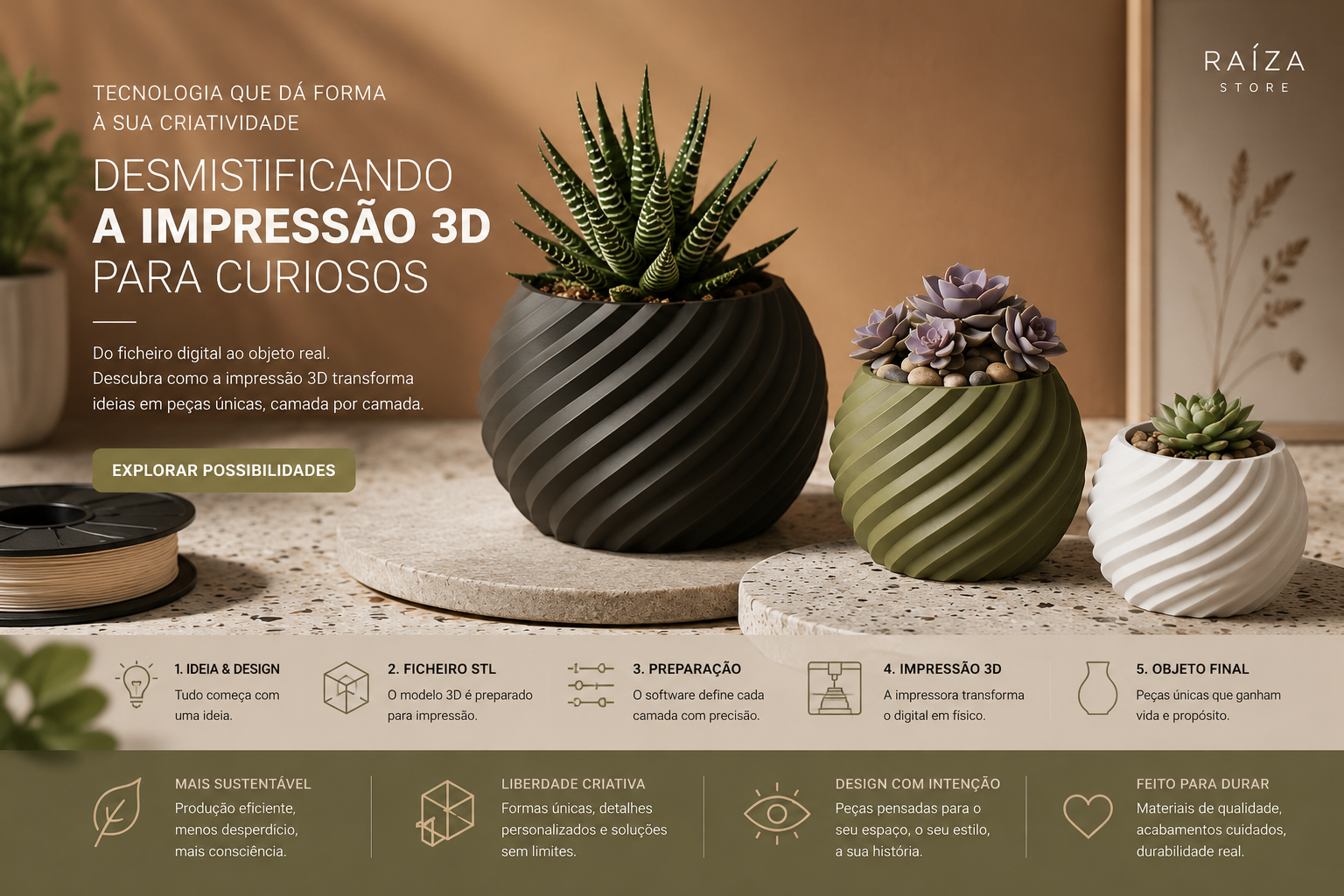
3D printing is no longer just a futuristic technology or something reserved for engineering. Today, it is increasingly present in design, decoration, and even everyday objects. But despite its growing popularity, a common question remains: how does 3D printing actually work?
The answer is simpler than it seems. It all starts with a digital file, usually in STL format, which acts as a "virtual mold" of the object. This file contains all the information the printer needs to create the part: dimensions, shapes, curves, and details.
Then one of the most widely used technologies today comes into play: FDM ( Fused Deposition Modeling ) 3D printing . The name may sound technical, but the concept is quite intuitive. The printer heats a filament, a thread-like material, and deposits it layer by layer until the final object is formed.
It is precisely this gradual construction process that allows for the creation of complex, organic, and detailed forms, often difficult to produce using traditional methods. Continuous curves, differentiated textures, or geometric patterns become possible with a high level of precision.
Beyond creative freedom, there's also an important practical component. 3D printing allows you to produce only what's needed, reducing material waste and avoiding overproduction. This makes the process more efficient and aligned with a more conscious consumption approach.
Another interesting aspect is customization. Since everything starts with a digital model, it's simpler to adapt sizes, adjust details, or create unique versions without needing to alter major production processes. It's this flexibility that makes 3D printing so relevant in the world of contemporary design.
And although technology is behind the process, the real focus remains the end result: pieces with identity, personality, and intention. Objects that don't look like they came from mass production, but are designed to integrate into a space in a more authentic way.
For many, seeing a piece being printed for the first time is almost mesmerizing. Layer after layer, the object slowly begins to take shape until it transforms into a real product. Perhaps that's why 3D printing sparks so much curiosity: because it manages to combine technology, creativity, and design in a visually fascinating way.
Today, more than a technological trend, 3D printing represents a new way of creating. More flexible, more personalized, and closer to what each person truly seeks.